Did Stop Killing Games Just Beat The ESA?
Stop Killing Games claims they've defeated the Electronic Software Association, but it's actually the third time. But maybe not the last.

Across the internet, gamers are celebrating. They believe the Stop Killing Games consumer movement just defeated the largest games industry lobbyists in the US, the ESA. But it’s more than that. This is the third time that the ESA have “lost” so far on this legal action. So does that mean that games are now saved from being deleted? Not quite. Despite what you might have heard, the fight’s not over yet. And with Stop Killing Games confirming to us that this bill would go farther than anything they’ve ever asked before? The scrutiny will only get more intense.
The Act
This is all happening in California’s state assembly. Assemblyman Chris Ward has introduced the Protect Our Games Act, which SKG representatives have advised on and are supporting as an organisation. Filed in February, this bill is moving through the legislative process toward becoming law. What would that law do? It would apply to any digital game available for purchase on or after January 1st 2027. So next year. It would require developers to give a 60-day warning before any service support ends, and then give players one of three options. A version of the game that works independently of the developers' systems, a patch that would allow the existing game to continue working, or a full refund for the game. Free-to-play and subscription-based games are out of scope, but any other server-dependent digital game would be required to still provide “ordinary use” of core features, as “consistent with reasonable expectations of a purchaser”. So that’s what’s at stake here. What vote did it just win?
Committees
On the 14th May, the bill underwent the third committee stage in the assembly. It had already passed Privacy and Consumer Protection, as well as Judiciary reviews from the relevant committees. So it didn’t obviously interfere with existing laws or breach consumer rights. This latest review was the appropriations committee, which is a very American process of government. Before money can be spent, it has to be approved for that specific purpose. In this case, the committee analysed the bill and worked out the fiscal effect. Here, that includes whether the Department of Justice would have to hire staff to investigate and prosecute cases, because they’re the only body authorised to. And whether the cost of trials would be high, especially at $1000 an hour to operate a courtroom. In both cases, they were found to be “an unknown but potentially moderate amount”. Not enough to be a problem, and so the Committee passed it. So, how are the ESA involved, and how did they lose?
The ESA Lost
Per a statement given to us by Pavel Zálešák, SKG’s deputy director of community and outreach, the Electronic Software Association industry body is doing what they always do.
The Entertainment Software Association is now pulling the same moves in the US that Video Games Europe used in Europe. By Opposing AB 1921 (California’s POG Act). They’re using the same old tactics.
This was in reference to a segment for ABC10 covering the movement of the bill, and the ESA giving a statement following requests for comments. They don’t agree with the bill at all; they think it mixes rights between ownership and licenses. They cite problems this could cause for developers and suggest that, in worst-case examples, the bill would impact the creators of these games in disproportionate ways.
Many games depend on evolving technology, licensed content, and online systems that change over time. Assembly Bill 1921 could force developers to spend limited time and resources keeping old systems running instead of creating new games, features, and technology. In the end, this policy doesn't reflect how games actually work today. This bill sets strict rules that could ultimately mean fewer new and innovative experiences for players.
Much of this was repeated in a “floor alert”, which is a letter distributed to lawmakers asking them to back the ESA’s interpretation of the bill and vote against it when it comes to them. The Stop Killing Games movement, due to the fact that they’re involved with this bill, got access to this post and republished it. They also added their own comments and rebuttals to the statements, producing a video that would go out to the public with Ross Scott going through it line by line.
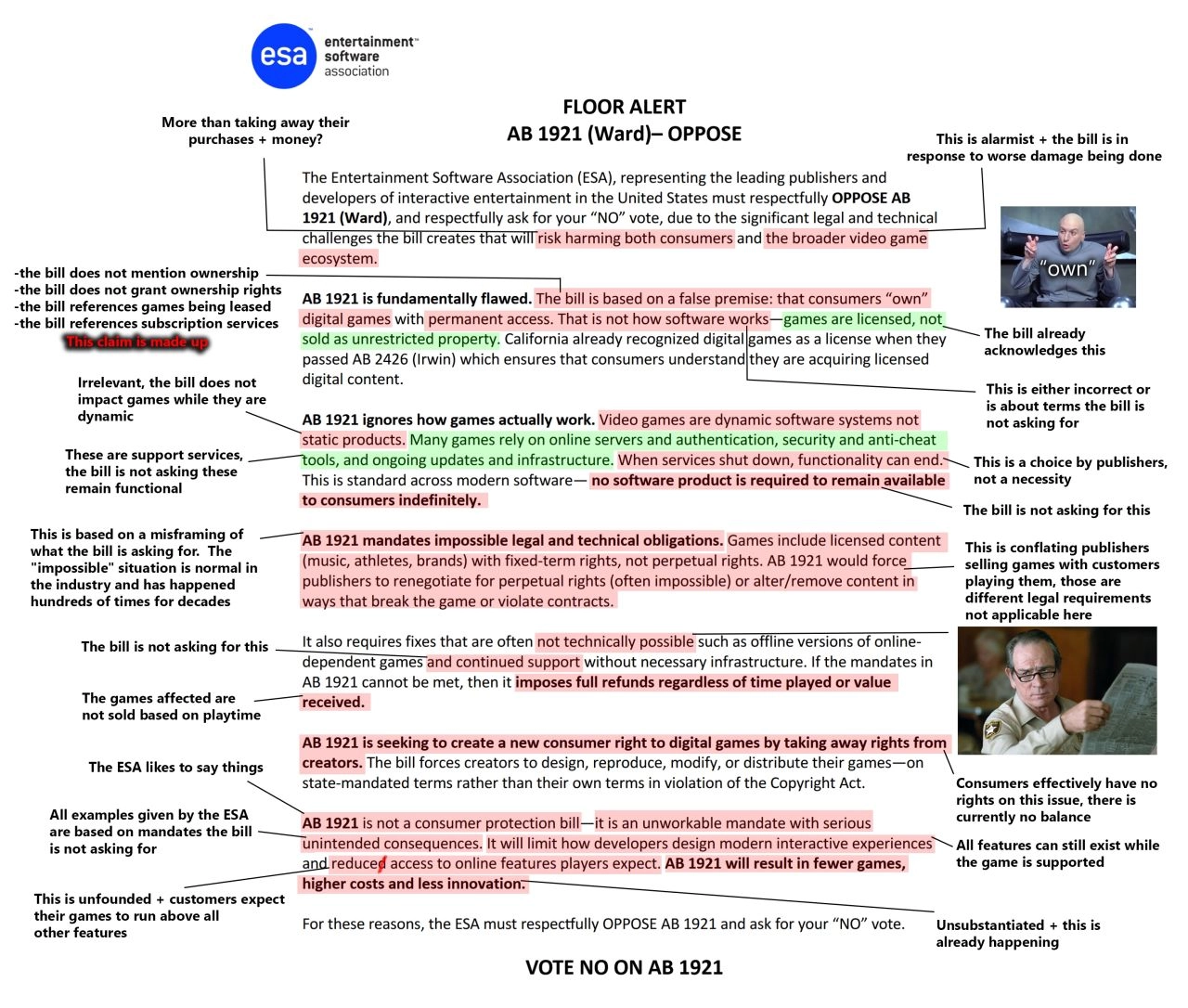
But this is overall nothing new. The reason the ESA produced this floor alert now is that the bill was almost certain to pass the appropriations committee. They had to lay the groundwork for what would come next. Because at every stage of this bill, the ESA has been a registered opponent to its passage. In that way, the Stop Killing Game’s movement’s posts about how they “won against the ESA in California” are correct. They’ve now “won” three times, at each committee. This represents about fifteen minutes of talking back and forth between legislators and their witnesses each time. Pretty much every point the ESA made while talking to the media was represented during these hearings. All SKG have done here is publicise them.
But if you take a look at the footage, it’s a fairly good-natured conversation where the bill’s proponent, Chris Ward, repeatedly mentions wanting to talk through the opposition’s concerns. Even suggesting he’s entirely okay with the idea of a “time limit on this kind of opportunities” - so perhaps a game that’s a decade old might not be subject to the limits of the law. This is simply regular legislative activity, which is a negotiation and scrutiny of legislation that could be worth millions of dollars. And it’s not done yet.
This was the final committee of the state assembly. From here, it passes to the floor of the assembly, where the whole house votes on it. Amendments can be made here if requested by other politicians. And then, the whole process starts again with California’s Senate. It will have to go through their committees for review, and then be voted on once again. In the event that it’s amended in one house but not the other, then there’s another vote, where they have to reconcile the differences and approve it. What’s important to take away from this is that this process is not over. There could be months of scrutiny. And that matters. Because, as SKG have told us, the intention of this bill is far deeper than anything they’ve asked before.
Retroactive
Within the last year, Stop Killing Game’s position has been that, with the EU citizens' initiative, they are not asking for any retroactive action for games.
Just to be clear, #StopKillingGames is not retroactive even if we wanted it to be. It would apply mostly to future games, if passed.
This California bill will be retroactive, and that’s intentional. It will apply to any digital game available for “purchase on or after January 1, 2027”. That wording was explicitly changed from “server-connected games published for sale on or after January 1, 2027”. SKG confirmed to us that Ward was responsible for the change, but that they were aligned with him on the intention.
If this bill passes, old games will be subject to this law, within seven months of this video being published. That means any currently available game that has a server-based component now has to think about whether it could be subject to this law. Because when enacted, it stops being about intention and becomes a case of interpretation and consequences.
The game that started all of this off was The Crew. Ubisoft responded to the frustration of players by announcing an offline mode for The Crew 2 in September 2024. It took them until October 2025 to get that into a shippable state, working around the existing limitations because they hadn’t planned from the start. It was an investment of time and resources, which Ubisoft, as a AAA, has, but that was still resources and time spent making an old game compliant rather than working on something new. But would it be enough for this bill?
“ordinary use” of core features, as “consistent with reasonable expectations of a purchaser”, will be the terms enshrined in law. That leaves a lot of space for interpretation. We brought this up last time, where Battlefield Hardline only having a single player campaign on console becomes a challenge for the courts. In The Crew 2, this offline mode has been updated to allow for custom skins, but it still lacks all multiplayer content and some UGC features. If any of those were part of the “reasonable expectations of a purchaser”, then Ubisoft might have a case to answer. Because there’s ambiguity here to navigate. And the penalty would be dire if they fail to deliver.
Stop Killing Games aren’t pretending that the refund option for developers is anything other than a worst-case scenario. It’s one we’ve seen play out recently, because Concord, for all its faults, gave everyone refunds. The only reason they couldn’t give a 60-day warning was that it only lasted 14 days. But for The Crew 2, it would be legally enshrined as the only option available if Ubisoft failed to meet those “reasonable expectations” when challenged by the state. All revenue from the game’s sales since 2018 would have to be returned to players. There would be no alternative; it would be the law.
Again, this does not just apply to new games that would have a chance to build their structures in compliance with this bill. Not just AAA games. This is something that affects every relevant game available for sale in California right now, and leaves it to the state to determine who will be held liable. If it passes in the current state.
Scrutiny Is Good
There are many steps left in this legislative process. Many points where the bill could be altered or finessed in such a way as to address concerns. Ward himself has shown that he’s open to this, the idea of time limits for when the bill could apply to games. And right now, even if you’re supporting the principles of this bill, you should want it to be scrutinised as heavily as possible. Because even if this passes the whole legislature of California, that’s not the end, either. Lawsuits challenging the bill's impact and viability will be near-guaranteed. The more seriously the bill is taken, the more challenge given to it and the more that everyone’s concerns are addressed? The more likely it is to survive in a state that everyone in games can be happy with.